Thursday, 22 August 2013

Watch Now: "Sikhs At Sandhurst" HD

This time last summer, my filmmaker colleague Juggy* and I walked through the corridors of Royal Military Academy, to discover the hidden history of "Sikhs at Sandhurst".

Being given rare access to film around the site was a tremendous honour- and on a hot English day we were duly rewarded for our efforts in capturing our glorious past with remarkable insight into the place where British (and Commonwealth) officers come to train.

It's a place that has a phenomenally strong Sikh presence- yet it's largely unknown to those outside of the military community.  As a reservist I've always been in awe of the glorious ways in which Sikhs are celebrated at Sandhurst, but many Indians might not appreciate it's sentiment or meaning without being prompted.

So we've made a film to highlight the Sikh story at this fine military institution - and crucially to provide a broader understanding of the Sikh presence there and what it means today.

It's our latest production from the "Sikhs At War" series of online films we make to raise awareness of our history and heritage.

In the film you will particularly discover:
- Why Queen Victoria gave special permission to the son of the last ruler of the Punjab to attend the academy
- Why the British deployed Sikhs in large numbers to unruly Afghanistan
- How the British chose to remember the Sikh bravery and heroics with a special stained glass window
- How British-Sikh history continues to inspire current generations to serve their country

"Sikhs At Sandhurst" is available to watch in HD widescreen below or here.


Sikhs have a unique and fascinating story of interaction with the British, something that as a third generation British Sikh I am very proud of and want to ensure people from all backgrounds appreciate too.

This interaction began with the Anglo-Sikh wars, which saw the British conquer the Punjab after two bloody wars which they nearly lost.  The fall of the Sikh empire was a tragic loss, but rather than remain enemies the Sikhs served the British and soon became the most trusted of allies.

This swift transition laid the foundations for the valiant contribution of the Sikhs on the frontier and during the World Wars, which we will be exploring as we head into the conflicts centenary.

We will soon bring you an update on how we intend to launch this film - and give it the international media publicity it deserves.  We will also be showcasing it worldwide at film festivals and presentations.

Until then - do watch and enjoy the film and do continue to visit and support all our channels and social media networks:

Twitter: @DotHyphen


* Final thought: a special thanks to Juggy Singh Rehnsi, my creative director (left), who has stood by this project and it's aims and aspirations through the technical difficulties we encountered in bringing you this story.

This film should have been released earlier than it has.  Not to bore you with details, but quality productions are very important to us.  So is being innovative and working with the limited resources we have to make films that do justice the story of Sikh bravery and heroism.

It is my hope that while we continue to use our expertise and passion for British Sikh history to bring you such productions, we also have your support in making them happen.

If you would like to contribute by funding or sponsoring a production please do email us directly.

Tuesday, 13 August 2013

Queen Victoria and Saragarhi

Much is made of Queen Victoria receiving news of the events at Saragarhi - but is this fact or fiction?

One myth already established, through my research for "Saragarhi: The Forgotten Battle" is that there was no standing ovation in Parliament as the news of the battle was read out.

This is incorrectly stated on many websites (including Wikipedia) and incorrectly pedaled by heritage types - I'd suggest going onto the official record of Parliament on Hansard and searching for yourself.

Another reason why no ovation took place is because it is not in order to clap in the chamber (while this rule has been tested in recent times e.g. Tony Blair's last PMQ's during Victorian England this would never have happened).

So what did Queen Victoria know of Saragarhi?  From my research I discovered that:
- Victoria was at Balmoral in Scotland at the time
- She received a Renter's telegram about the battle four days after it happened

And most importantly:
- She writes about the “splendid behaviour of the Sikhs in defending Fort Cavagnari for 30 hours.”

More details can be found in "Saragarhi: The Forgotten Battle"

[PS would someone like to update Wikipedia?!]

Monday, 12 August 2013

Remembering Saragarhi: Author's Interview with Jay Singh-Sohal

Here's the latest "Remembering Saragarhi" clip.

In it, I answer the four questions that people always ask me about Saragarhi:
- What is it?
- What exactly happened?
- Why write about it
- Why was it forgotten.

In short, here's some answers from the clip:
- It's a battle of epic proportions that took place  in 1897
- 21Sikhs made a defiant last stand against 10,000 Pathans, fought and died
- Because it needs exploration through factual history
- It was overshadowed by other campaigns and eventually the Great War, but it's significance is strong


Monday, 29 July 2013

Sikhs At Sandhurst will be releasing soon - watch this space!

The film tells the story of the British-Sikh experience captured at Sandhurst, as well as the first person of Sikh descent to attend the Royal Military Academy.

Wednesday, 17 July 2013

Remembering Saragarhi at the launch of NSRF

In my speech at the recent launch of the "National Sikh Remembrance Foundation", I spoke about acts of bravery such as Saragarhi, and its meaning for British Sikhs today:


Friday, 5 July 2013

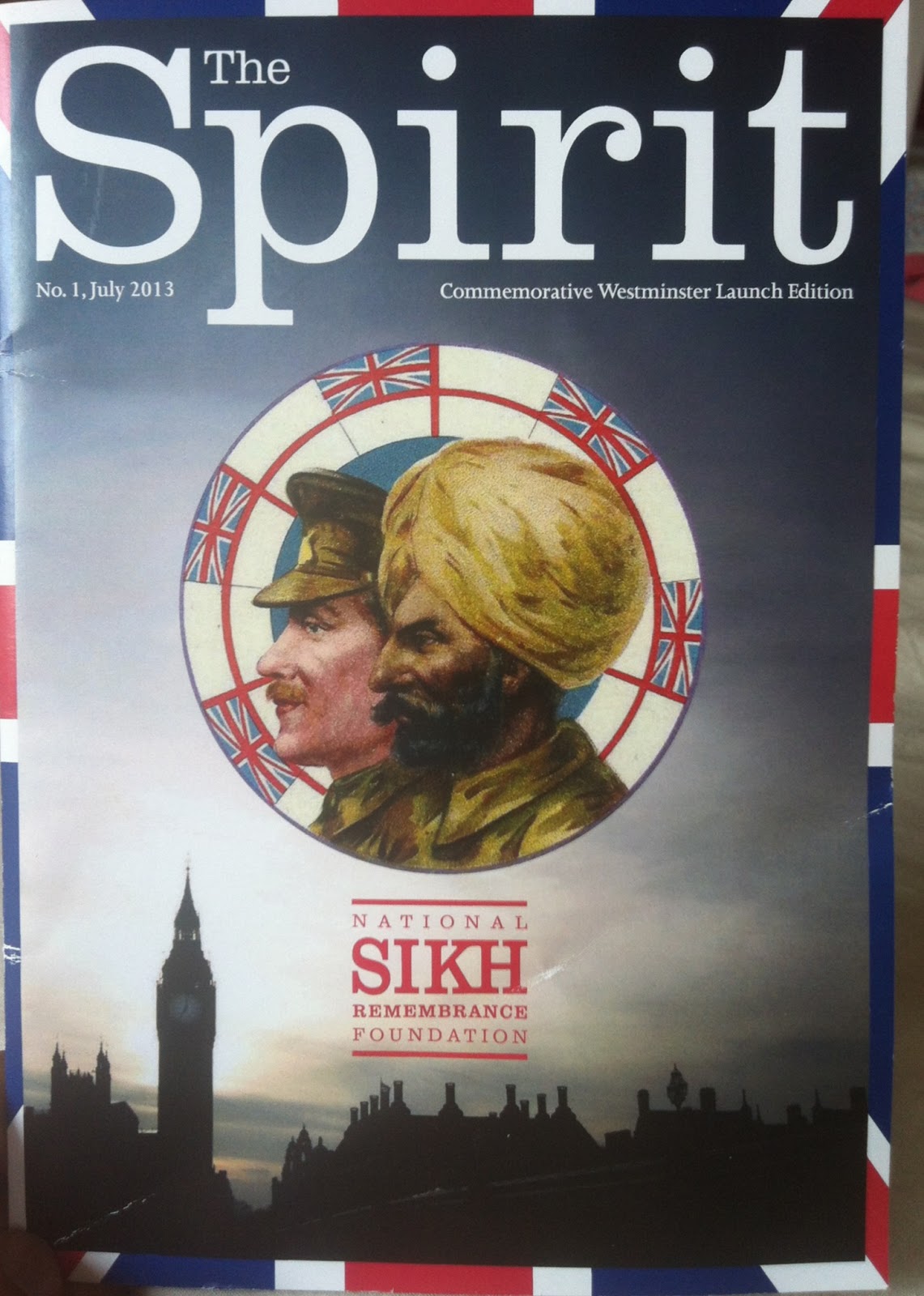
National Sikh Remembrance Foundation

I had the pleasure of speaking at the launch of the National Sikh Remembrance Foundation yesterday (4th July).

The NSRF was launched by the Attorney General Dominic Grieve and Paul Uppal MP.

The trustees, including Cllr Santokh Singh Chhokkar, have done a fantastic job in setting up an organisation to work with the Royal British Legion and others in commemorating the Sikh contribution during the Great War.

Their commemorative launch magazine is on the left.

The launch was an excellent chance to hear from dignitaries about the Sikh contribution during the War, as well as speak to people about it too.

Below is my speech from the event.  If you quote from it please ensure you attribute it to "Jay Singh-Sohal":


"As we head into the anniversary year commemorating the start of the Great War it’s important for us all to remember the contributions of the Sikhs AND to ensure their story is also remembered in wider society.

After all – our success today as British Sikhs is due to the historic and heroic contribution of those from the subcontinent who defended Britain and thereafter found a welcome home on these shores.

We can take immense pride as a community in the 150 years of British and Sikh interaction.  Particularly as Sikhs chose to serve in the Empire that had annexed the Punjab – they stayed loyal during India Mutiny and they fought on the unruly frontier with Afghanistan.

Alongside them there in Malakand was a young Winston Churchill – who said of them: “the Sikh will go on under circumstances which will dishearten and discourage his rival.”

If to prove his point - shortly thereafter at Saragarhi - 21 Sikhs stood firm against 10,000 enemy tribesmen.  Cut off from reinforcements and facing overwhelming odds– they made a gallant last stand - fought – and died – rather than surrender or flee.

In these frontier wars the Sikhs earned their spurs - cementing their reputation as brave, loyal and the staunchest of British Indian soldiers – before their need even arose in the Great War.

My forthcoming publication “Saragarhi: The Forgotten Battle” details this – and WHY they selflessly served Britain:  It’s because their martial creed as Sikhs fostered a belief in fighting for a righteous cause; embracing the will of God and – if need be - sacrificing their life for a higher purpose.

They reflected on the words of the tenth Guru Gobind Singh - in remembering WHY they fought injustice and tyranny.  It is our national anthem:


Sikhs fought for the British – from the frontier to the fields of Flanders - because they were warriors.  They had sworn an oath to do so – because they believed the British Raj would benefit their people.  They heard stories of how the Guru had told of their coming and how it would spread the seed of Sikhi.

Whether that prophecy is true or not is insignificant ...letters sent by Sikhs from the trenches of Europe to the sands of Mesopotamia show that those who fought for the British believed in it.
In retrospect we can see that service in Empire enabled the Sikhs to spread worldwide, doing what Sikhs do best – and creating – friendships, communities, places of worship, families, businesses ... prosperity. 

From British Columbia  to Hong Kong.  Tanzania to New Zealand – and all the places in between, you can always spot a Sikh!

We British Sikhs are the best example of this legacy –we’ve followed in the footsteps of our ancestors who served– and been honourable, honest and hard working servants of society.  Only rather than the battlefield we now make our mark in business and commerce; defending the interests of Britain by creating wealth.

Dare I say we even exude conservative qualities – of duty, tradition, and strong family values.
But along the way we’ve somewhat lost track of the need to tell others – in fact to boast - of the immense contribution Sikhs made in fighting to uphold the rights and freedoms of ALL.

As a British Army reservist - I welcome the launch of the National Sikh Remembrance Foundation to ensure this story is placed high in public consciousness– and educates a new generation - about the War and those who fought in it.

I leave you with the words of General Sir William Lockhart, who remarked after the battle of Saragarhi that: “may the heroic national spirit of the Khalsa continue and flourish, and in future wars may Sikhs ever be found fighting as trusty comrades side by side with their British brothers-in-arms.”

That they did – but let it not be forgotten.  Let’s ensure this spirit continues to be remembered –and inspires others to serve our country - with works that make the story of Sikhs At War resonate within all corners of society.  

They did their duty – it is now time for ours."

A video of the speech will be updated here in due course.


Thursday, 20 June 2013

Canon at Saragarhi Gurdwara, Ferozepur

My last post, about losing the heritage of Saragarhi, was met with much response, negative and positive towards the issue of Punjab losing it's history.

But I re-iterate what I said earlier, appreciating heritage and the memorials to those who fought and died is crucial not just for us but future generations.

Establishing fact and researching deeper into historic events to find the truth is also key.  I feel privileged in being able to do this with my journalistic skills, military know-how and understanding of Sikh faith and values.

I recommend that you all also try and discover more about Sikh heritage - ask questions and read more.

It's something I regularly do, and here is a point in case.

The the state of the Saragarhi memorial in Ferozepur brought much joy, kept in much better condition than the 1901 memorial in Amritsar and a thriving Gurdwara where langar is served and visitors regularly attend.

But my attention was drawn towards the canon placed at the four entrances to the Gurdwara.

What were they?  Where were they from?  And how did they get to the memorial?

With help from Neil Carleton, an expert on historic gun pieces, I can shed some light on these canon, and hopefully raise more factual awareness about something which you might take for granted at the memorial.


Here is the paragraph from my forthcoming book "Saragarhi: The Forgotten Battle":

"
"Outside the memorial are placed canon at each of the four entrances; one light 6-pound field gun and two 9-pound wheeled carriage guns.  The latter is an example of a bronze field gun which saw service in the East India Company during the Anglo-Sikh Wars, a rare treat as these were melted down for scrap metal and replaced by iron and steel artillery pieces from the 1860's.  The lighter gun is dated 1856 and from its inscription we can tell it was built by Captain A. Broome who was in charge of the British gun foundry at Cossipore on the Hooghly river near Calcutta.  It is possible that these treasured pieces saw action against the Sikhs and during India Mutiny, but now in a twist of irony they stand as guardians to the sacred Sikh scriptures placed inside the Gurdwara."

Please do, as always, message me and comment here on these posts.  But also, should you find yourself in Punjab, make a pilgrimage to the Saragarhi memorials in Amritsar and Ferozpur - in remembrance to those who fought on the Samana and their enduring legacy.

PS - if you are quoting this post, as some websites are, please make sure you attribute it properly!
http://sikhs-at-war.blogspot.co.uk/

Tuesday, 4 June 2013

Losing Saragarhi's Heritage

It was with much sadness that I saw the below scene of the Saragarhi memorial in Amritsar.


This was the memorial created after the battle in which 21 Sikhs heroically stood to the last against 10,000 Afghan tribesmen on the frontier.

Their last stand, chronicled in my next book, cemented the reputation of Sikhs as brave and loyal soldiers of the British Empire.  A reputation still remembered to this day, albeit not as much as it should be.

This post is about the decline of Indian (specifically Punjabi) heritage.

The memorial Gurdwara was unveiled on 16th April 1902 by General Sir Arthur Power Palmer, the Commander-in-Chief, who said:  “The memorial is the outcome of the spontaneous appreciation of the gallantry of a representative detachment of the Sikh nation, proving that they possess one of the finest of soldierly characteristics – namely, that they prefer death to surrender.”

The names of the 20 Sikh soldiers under Havildar Ishar Singh were written onto plaques outside the front door leading to the Guru Granth Sahib, the names were to:  "...be kept as an example to others, in order to show how brave men should behave when facing fearful odds." said Power Palmer.

So it's very sad then that the memorial is falling into a dilapidated state.  It needs repairs and freshening up, as does the grounds around it.

But rather than preserving this memorial, the SGPC (in charge of Sikh shrines) seem more interested in building accommodations for foreign devotees (Sikhs and non) who visit the holy city of Amrtisar.  The building which looms over the memorial is such a hostel, which will no doubt when complete dwarf the Saragarhi memorial.

This is a surprise, as in recent years Saragarhi seems to have made a resurgence as a story of bravery, with Sikhs trying to bring back awareness of it through various means, the SGPC commissioning artwork and a cartoon book on the story being released.

But the state of the old memorial is an example of Punjab losing it's physical heritage, which are being bulldozed and replaced with western-friendly facades.

In this instance, the memorial hasn't suffered that fate (yet) - but awareness of historic actions which the Sikhs were involved in are in danger of being forgotten if not becoming merely political ploys for the establishment.  The lessons they contain and the context of their history are seen as no longer relevant.

Power Palmer, in 1902, also stated that the memorial was erected at the headquarters of the Sikhs so that:  "...as long as the British rule lasted the brave Sikh soldiers of the King might realize that their deeds would never be forgotten.”

Perhaps its because of this connection to Empire that the memorial has been forgotten about?  Can Sikhs no longer feel proud of their contribution during the history of British India?  Is it too difficult given the independence movement?  Is it too embarrassing for ruling elites to propagate?  Or simply a fruitless endeavor?  Or do the simple folk who have little reading of such history simply not care?

I, for one, take a lot from the story of Saragarhi - but then I am a British Sikh and feel a connection between it and the subsequent heroics during the World Wars and then the migration and integration of Sikhs in Britain thereafter.

Whatever the outlook, heritage groups are missing in this equation - where are they?  Are there any in India who'll work to fund repairs at the memorial?  The UK-based heritage groups seem more interested in posh polo matches, is the story of Saragarhi becoming abused for others gain?  What about groups in the USA/Canada, where there are a lot of Sikhs?  I'd like to know your views ...

My hope is that someone will take this post to heart to work to restore the memorial.  But the effort must come domestically within India, there is not much we in the diaspora can do - money is not the answer to everything, as Sikhs abroad seem to be thought of as cash cows by our Indian cousins.

Rather, Indians in India MUST work to protect our memorials, such as Saragarhi, for generations to come. If it was in my back yard, I would! 

To conserve our heritage we must embrace it and radiate it's significance to those who can see, feel and taste its presence.  The old adage stands, we shape our buildings and thereafter our buildings shape us.

I feel like I've done my part by writing a book about the factual story of Saragarhi and its significance, to be released in September 2013.

It's now for others to take it and the story of Saragarhi to ensure it is not forgotten, but that the heritage connected to it is also not lost.

What to call my Saragarhi book

During my research into "Saragarhi" I thought long and hard about what to call the book.

Is it a lost battle?  Is it a true narrative of events?  Is it about the politics of the Raj or the Sikhs?

The original concept for my work was about the "21 Sikhs" and the last stand at Saragarhi - but with its proven hard to tell the stories of the individuals involved at the battle because so little primary material exists.

I went for "The Forgotten Battle" because the events of Saragarhi have been largely lost to mass public consciousness.

It fits my theory also, that the myth of the battle and the falsities that have cropped up are now more well known than the actual fact of what happened at Saragarhi.  This involved the wrongful claims that the battle was ranked by UNESCO, that news of the event raised a round of applause in the Commons.  There are more also.

Saragarhi is a forgotten battle for another reason, for access is no longer possible to the area where it took place.  To discover more about the battle and why it took place, we need an appreciation of the geography of the land and the significance of the communications post.

This is detailed in my book which will be released in September 2013.

Tuesday, 28 May 2013

Sikhs and the EDL

It's late, a little before midnight, and I'm writing my latest book "Saragarhi: The Forgotten Battle."

The chapter I'm currently drafting is about the subsequent aftermath of Saragarhi, where 21 Sikhs fought bravely to the last against the onslaught of 10,000 Pathans in 1897.  And what happened after the Samana range, which was defended by a mix of Sikh and Royal Irish troops, was cleared of the enemy.

What happened next was that the British forces (comprising Sikhs also) were sent to the Tirah to deal with the tribes there who had caused such havoc on the frontier.  This was one of many expeditionary forces into Afghanistan before the turn of the century.

And this was before the Sikhs were sent to fight in the Great War and Second World War.

So looking for a short break from writing, I turn to that tool of procrastination that is Facebook; and click on a link a friend has shared with me.

It is about an EDL rally that took place earlier near the Cenotaph where the speaker references the bravery of the Sikhs.

I've been out the news loop today so I watch and I listen.

Then I trawl down my FB timeline and notice other Sikh friends sharing the same video.

So the English Defence League find it fitting to talk about the bravery of the Sikhs during the Wars, and Churchill's admiration that the Sikhs were vital to the war effort.

Thank you EDL for the reminder of this history.

But should Sikhs support the EDL in their endeavours as they seem to like the community because they are integrated in Britain, and not waging holy war against the UK?

This is the crux of what the video, the statement in it, and the social media sharing that is going on must surely centre on.

But wait, I hear you say, as a blog that promotes British Sikh history during the Great War is it the realm of this medium to share thoughts on such a highly political matter?

Probably not.

I'll do it anyway.

But I'll do so without passing an opinion on whether Sikhs should support the EDL - that isn't a community matter but a personal and individual one.  One which each Sikh out there needs to find an answer for themselves - much like who to vote for or what to have for lunch.

Nor will I pass judgment on those friends who I know have shared the EDL/Sikh video and other material, I know some people who do support the group that aren't white, skin heads or racist, but that's all.

And I won't indulge in the topic of talking up or down Islam; I'm not Muslim so I can't say much for how they feel after the horrific death of Drummer Lee Rigby at the hands of someone who called himself a Muslim.  But I'll presume he wasn't a good one because not all Muslims run around trying to behead Brits (or maybe it's the whole Muslim community that aren't really Muslims because they're not trying to .... ???)

Anyway .... what I will talk about though, keeping to the historic purpose of this blog and away from statements that might inflame someone to declare a jihad against it; is another element of forgotten British history which members of the EDL or anyone thinking of going on an anti-Islamic crusade should think about.

And that's that it wasn't only the Sikhs who fought for Britain during the World Wars.

Plenty of Muslims did too!

The Punjab Regiments that we are so proud of that fought in the trenches of Flanders, fought to capture Baghdad, fought in east Africa, fought in Europe and in Burma and else where ... were made up of x2 companies of Punjabi Mussulman - and they fought alongside Sikhs.

This might have been a long-winded posting to just saw that, but that was the gist of what I wanted to impart in this blog.

But for those Sikhs reading this and wanting some sort of a political response to whether the Sikhs should be supporting the EDL I will share my opinion by saying this:  engage with the political system, engage with the media and be a player within the civil society that we live in.

Should you fail to raise your voice and be heard in the arena's of our liberal democracy we so strive to protect, then I think you will be entitled to join any ultra right/left/up/down group you desire.

Should you fail...